Indian Ring Size Chart and How to Measure Your Finger Accurately
The Indian ring size system is simpler than it looks: the size number is the inside circumference of the ring in millimetres, minus forty. Once you know that, the full chart follows — and so does the reason most at-home measurements come out half a size wrong.
The short answer
An Indian ring size number equals the ring's inside circumference in millimetres minus 40. So Indian size 12 is a ring measuring 52 mm around the inside, with an inside diameter of 16.55 mm. Sizes run from 1 to 30, though most adult Indian buyers fall between 6 and 26. To find your size at home, wrap a strip of paper snugly around the base of the finger, mark where it overlaps, measure that length in millimetres and subtract 40. Measure late in the day at normal room temperature, and measure three times.
On this page
How the Indian ring size system works
Different countries size rings differently. The United States uses a numeric scale with halves and quarters. Britain uses letters. The international standard, ISO 8653, does something more sensible than either: it designates a ring size by its inside circumference measured in millimetres, so the size is the measurement.
India uses a numeric scale that sits directly on top of that standard, offset by forty:
The two formulas you need
Indian ring size = inside circumference in mm − 40
Inside circumference = inside diameter × π (π ≈ 3.1416)
A ring measuring 52 mm around the inside is Indian size 12. Its inside diameter is 52 ÷ 3.1416 = 16.55 mm. Every row of the chart below is generated from those two relationships, which is why the numbers are internally consistent rather than approximate.
One consequence worth noting: each full Indian size adds exactly 1 mm of circumference, and therefore only about 0.32 mm of diameter. A third of a millimetre is roughly the thickness of a few sheets of paper. This is why ring sizing has so little tolerance for a sloppy measurement, and why a paper strip that stretches slightly will hand you the wrong answer with total confidence.
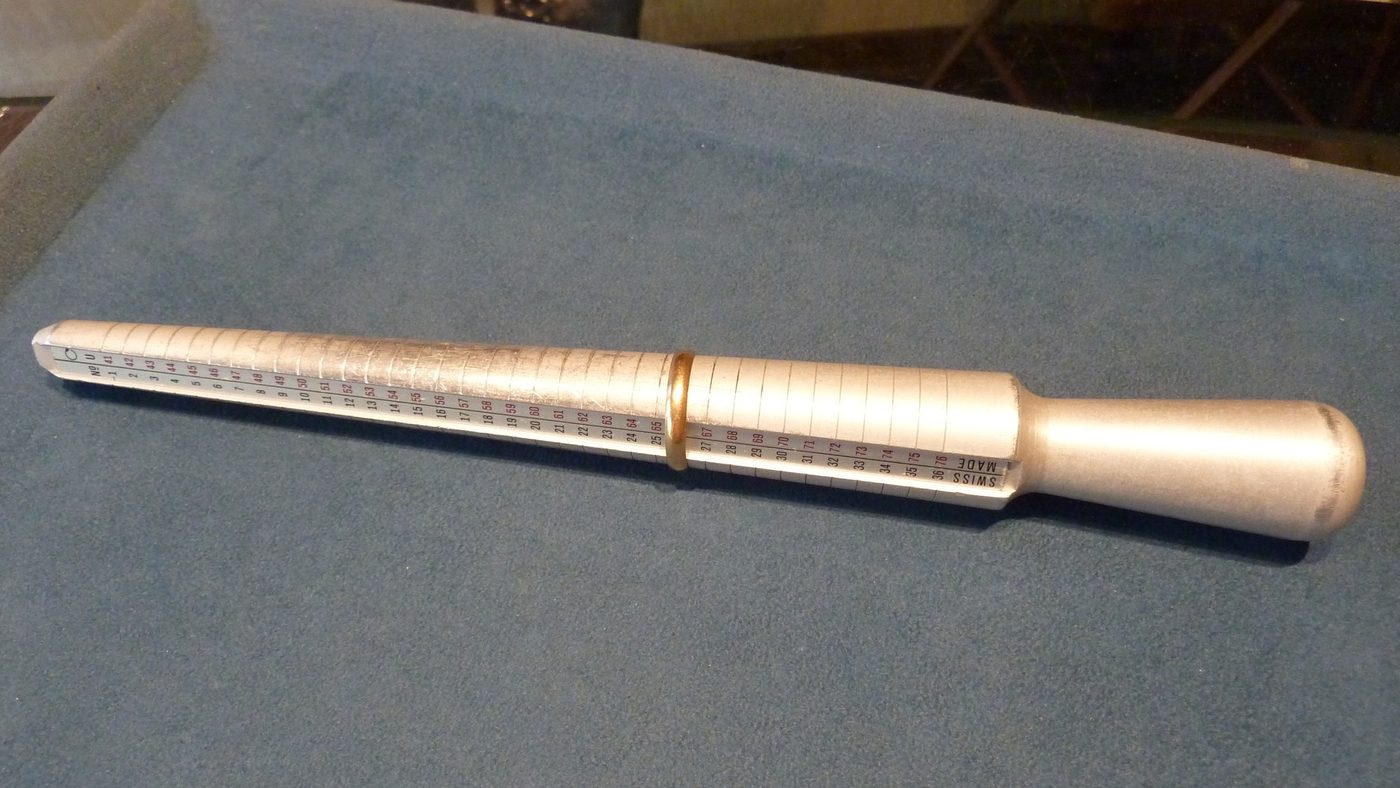
Indian ring size chart
| Indian size | Circumference (mm) | Diameter (mm) | US / Canada | UK / Australia |
|---|---|---|---|---|
| 1 | 41 | 13.05 | 1 | B |
| 2 | 42 | 13.37 | 2 | D |
| 3 | 43 | 13.69 | 2½ | E |
| 4 | 44 | 14.01 | 3 | F½ |
| 5 | 45 | 14.32 | 3¼ | G |
| 6 | 46 | 14.64 | 3¾ | H |
| 7 | 47 | 14.96 | 4 | H½ |
| 8 | 48 | 15.28 | 4½ | I½ |
| 9 | 49 | 15.60 | 5 | J½ |
| 10 | 50 | 15.92 | 5½ | K |
| 11 | 51 | 16.23 | 5¾ | L |
| 12 | 52 | 16.55 | 6 | L½ |
| 13 | 53 | 16.87 | 6½ | M½ |
| 14 | 54 | 17.19 | 7 | N½ |
| 15 | 55 | 17.51 | 7¼ | O |
| 16 | 56 | 17.83 | 7½ | P |
| 17 | 57 | 18.14 | 8 | P½ |
| 18 | 58 | 18.46 | 8½ | Q½ |
| 19 | 59 | 18.78 | 8¾ | R |
| 20 | 60 | 19.10 | 9 | S |
| 21 | 61 | 19.42 | 9½ | S½ |
| 22 | 62 | 19.74 | 10 | T½ |
| 23 | 63 | 20.05 | 10¼ | U½ |
| 24 | 64 | 20.37 | 10¾ | V |
| 25 | 65 | 20.69 | 11 | W |
| 26 | 66 | 21.01 | 11½ | W½ |
| 27 | 67 | 21.33 | 12 | X½ |
| 28 | 68 | 21.65 | 12¼ | Y |
| 29 | 69 | 21.96 | 12¾ | Z |
| 30 | 70 | 22.28 | 13 | Z½ |
As a rough orientation: Indian sizes 10 to 16 cover most women's ring fingers, and 18 to 24 most men's. Those are starting points for a conversation, not a substitute for measuring.
Charts vary slightly between jewellers
You will find published Indian charts that differ from this one by a tenth or two of a millimetre, because some houses round circumference to the nearest whole number and others carry a decimal, and mandrels themselves have manufacturing tolerances. Those differences are smaller than the difference a warm afternoon makes to your finger. What matters is that you and your jeweller size against the same mandrel — which is the honest argument for having the final measurement taken in person on the set you are actually buying.
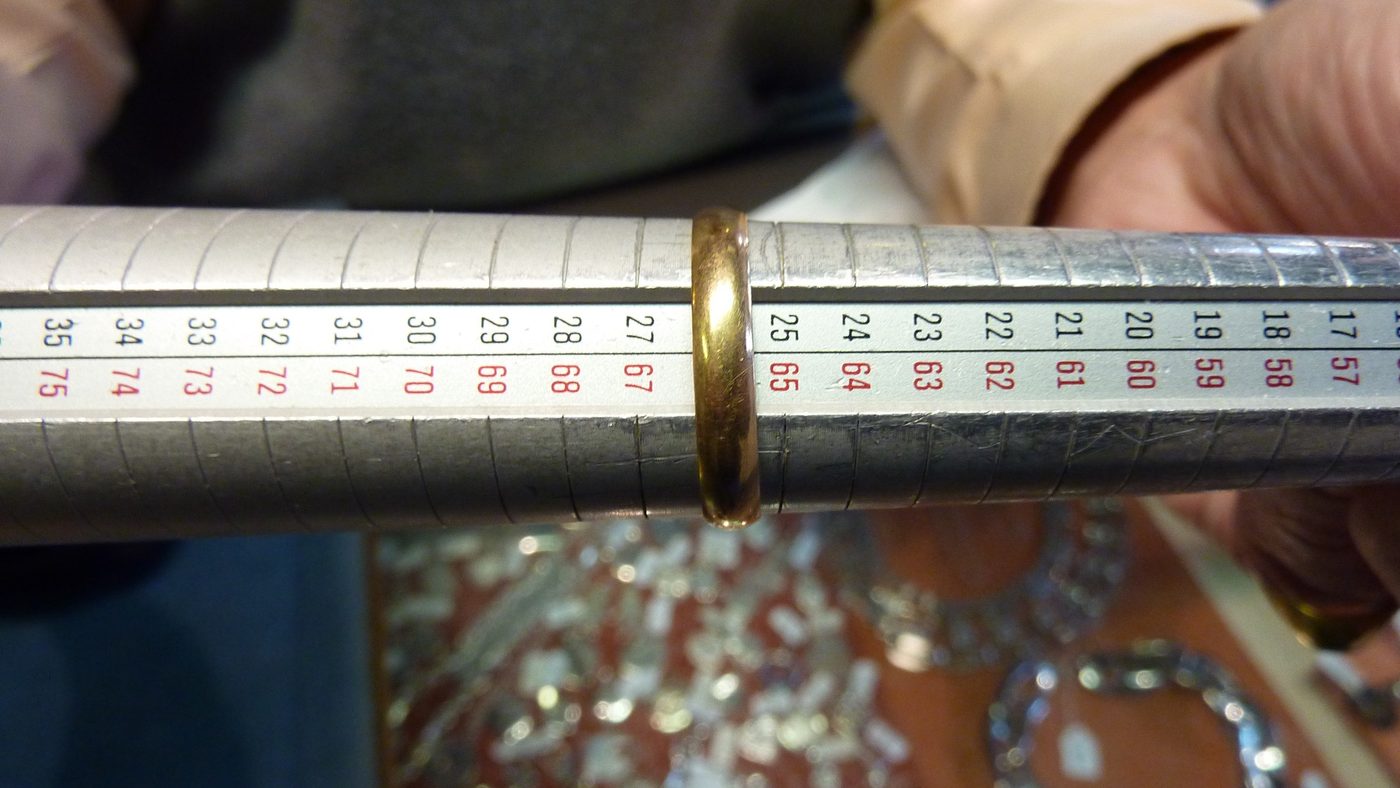
Measuring at home
Paper strip, ruler, three attempts. It is this simple, provided you respect the failure modes.
- Cut a strip of ordinary paper about 5 mm wide and 100 mm long. Paper, not thread, and not sellotape.
- Wrap it around the base of the finger — the part the ring will actually sit on. Snug enough that it will not slide off, loose enough that you can rotate it without the skin bunching.
- Mark where the end overlaps with a fine pen, marking the strip rather than pressing into your finger.
- Lay the strip flat and measure from the end to the mark in millimetres, against a steel ruler if you have one.
- Subtract 40. That is your Indian size. 53 mm becomes size 13.
- Do it twice more, at different times of day, with a fresh strip each time. If your three readings disagree by more than a millimetre, the technique is the problem, not the finger.
Then check the answer over the knuckle, which is the step that matters and which we come back to below.
Measuring a ring you already own
If the person already owns a ring that fits the correct finger, this is the more reliable route — but only if you measure the right thing.
Measure the inside diameter, across the widest point of the inner circle, not the outside of the band. On a substantial ring the difference between inside and outside diameter can be two or three millimetres, which is six to nine full Indian sizes. This single error is the most common cause of a ring arriving hopelessly large.
Find the inside diameter in the chart above and read across. If it falls between two rows, take the larger size — a ring slightly too big can be brought in, whereas one too small may not be able to go out at all.
And be sure the ring you are measuring belongs on the finger you are buying for. Right hands are commonly a little larger than left in right-handed people, and a ring worn on the middle finger tells you very little about the ring finger.
Six ways home measurements go wrong
- String and thread stretch. Cotton thread lengthens under the tension you naturally apply, giving a reading that is too long and a size too large. Use paper.
- Measuring cold hands. Fingers shrink in the cold. Measure at comfortable room temperature, not just after coming in from an air-conditioned car or washing in cold water.
- Measuring first thing in the morning. Many people are slightly puffy on waking. Late afternoon or evening is a better proxy for the average day.
- Printing a paper ring sizer at the wrong scale. Printable sizers are only valid at exactly 100% scale, and printer drivers love to apply “fit to page” silently. If you use one, verify it against a ruler before trusting it.
- Pulling the strip tight. A ring has to pass the knuckle, then sit comfortably at the base. Measured too tight, you get a ring that will not go on.
- Measuring the wrong finger, or after exercise. Hands swell after activity, heat and salty food. None of these are the state you will spend most of your life in.
Your ring size is not a fixed number
Fingers change size, routinely and by meaningful amounts. Over a single day, most people's fingers are smallest in the morning and largest in the evening. Across a year, they are smaller in a Bengaluru January than in the humidity before the monsoon breaks.
Beyond the daily cycle, size shifts with weight change in either direction, pregnancy, salt intake, long flights, and some medications; and with age, arthritic changes in the knuckle can leave a joint that is wider than the base of the finger by a considerable margin.
The practical implications:
- Aim for the size that fits your ordinary state, not your smallest or largest.
- A correctly fitted ring goes on with light pressure, sits without spinning freely, and comes off over the knuckle with slight resistance. That resistance is the point — it is what stops the ring leaving your hand without you noticing.
- Do not size a wedding band during a heatwave, on the day of a long flight, or immediately after the gym.
Band width and knuckles
Two adjustments that catch out people who have measured perfectly.
Wide bands fit tighter
A broad band covers more of the finger and grips along its whole width, so a wide ring in your measured size will feel tighter than a thin one in the same size. Trade practice is to go up about a quarter to a half size for bands wider than roughly 6 mm. Since Indian sizes step in whole numbers, that often means trying both your measured size and the next one up in the actual width you are buying.
Size the knuckle, then the base
The ring has to clear the knuckle to get on, and stay put at the base once it is there. Where the knuckle is much larger than the base — common, and more so with age — a ring sized to pass the knuckle will spin at the base.
The solution is mechanical, not a compromise on size. Sizing beads, a small internal bar, or a slightly ovalised inner profile let a ring pass a large knuckle and then sit correctly. Any of these can be fitted by a workshop; all are far better than living with a ring that turns, because a ring that spins wears unevenly and puts its stones where knocks happen.
Buying as a surprise
Some approaches that work, in rough order of reliability:
- Borrow a ring she already wears on that finger and have it measured properly. The most accurate option by a distance.
- Ask someone who would know — a sister, a close friend, a mother. Discretion is usually available if you ask for it.
- Press a borrowed ring into a bar of soap and bring the impression in. Crude, but it preserves the inside diameter well enough to be useful.
- Buy slightly large and plan to resize. Bringing a ring in is a routine workshop job on most plain and simple settings. Ask before you buy whether the specific design can be altered.
Ask us before you guess
If you are buying from us and cannot get a measurement, say so. We would far rather size the ring properly after the proposal than have you commit to a number you are not confident about. Our team can also talk you through measuring over the phone or on a video call — call +91 80 6969 1869.
What can be resized, and what cannot
Ask this before you buy, not after. It is design-dependent and the answer changes the purchase.
| Type of ring | Can it be resized? | Notes |
|---|---|---|
| Plain gold band | Yes, readily | Usually one or two sizes either way without difficulty |
| Solitaire with a plain shank | Yes | The shank is altered; the setting is untouched |
| Ring with stones part-way down the shank | Within limits | Only the plain section can be worked, so the range is smaller |
| Channel-set band | Marginally | Altering the circumference risks the channel walls losing their grip |
| Full eternity ring | Generally no | Stones all the way round leave nowhere to cut. Usually remade rather than resized |
| Tension setting | No | The stone is held by calculated spring tension; changing the circumference changes the tension |
| Platinum | Yes, with more work | Higher melting point and different working properties; expect longer and dearer than gold |
| Ring with engraving inside | Yes, with a caveat | Resizing may cut through the engraving; ask what will be lost |
A related point on repeated alteration: every resize means cutting, adding or removing metal, and soldering. Done well it is invisible and the ring is as strong as before. Done repeatedly over decades, on a thin shank, it accumulates. If a ring has been resized several times already and the shank feels thin, the better answer may be to have the shank rebuilt.
Sizing rewards a little patience: measure three times in the evening, on the correct finger, in the width you actually intend to buy. And when the piece matters — an engagement ring, a wedding band, something meant to be worn for fifty years — have it measured on a proper mandrel in person. A third of a millimetre decides whether a ring is worn or left in a drawer.
Frequently asked questions
How do I know my ring size in India?
Wrap a 5 mm wide strip of paper snugly around the base of the finger, mark where the end overlaps, lay the strip flat and measure the length in millimetres. Subtract 40 from that measurement and the result is your Indian ring size. A strip measuring 53 mm means Indian size 13. Measure three times at different times of day, using a fresh strip each time, and check that the size will also pass over the knuckle.
What is the formula for Indian ring size?
An Indian ring size number equals the ring's inside circumference in millimetres minus 40. Inside circumference relates to inside diameter by circumference equals diameter multiplied by pi, approximately 3.1416. So Indian size 12 is a ring with a 52 mm inside circumference and a 16.55 mm inside diameter.
What is Indian ring size 12 in mm?
Indian ring size 12 has an inside circumference of 52 mm and an inside diameter of 16.55 mm. It corresponds to approximately US size 6 and UK size L and a half.
What is the most common ring size in India?
As a broad orientation, Indian sizes 10 to 16 cover most women's ring fingers and 18 to 24 cover most men's. These are useful starting points rather than substitutes for measuring, since finger size varies considerably between individuals.
How many mm is one Indian ring size?
Each full Indian ring size adds exactly 1 mm of inside circumference, which works out to only about 0.32 mm of inside diameter. That small a difference is why ring sizing has little tolerance for imprecise measurement, and why a paper strip that stretches will give a confidently wrong answer.
Should I measure my ring size in the morning or evening?
Evening, or late afternoon. Most people's fingers are at their smallest in the morning and largest by the end of the day, so an evening measurement better reflects your ordinary state. Avoid measuring when your hands are cold, immediately after exercise, after a salty meal, or on the day of a long flight, as all of these shift finger size.
Can I measure my ring size with a thread or string?
It is not reliable. Cotton thread and string stretch under the tension you naturally apply while wrapping, producing a reading that is too long and therefore a size too large. Use a strip of ordinary paper about 5 mm wide instead, which does not stretch appreciably.
How do I measure a ring I already own?
Measure the inside diameter across the widest point of the inner circle, not the outside of the band. On a substantial ring the difference between inside and outside diameter can be two to three millimetres, which is six to nine full Indian sizes, and this is the most common reason a ring arrives far too large. Then find that diameter in the size chart. If it falls between two rows, take the larger size.
Does band width change the ring size I need?
Yes. A wide band covers more of the finger and grips along its whole width, so it feels tighter than a thin band of the same size. Trade practice is to go up roughly a quarter to a half size for bands wider than about 6 mm. Because Indian sizes step in whole numbers, the practical approach is to try both your measured size and the next one up in the actual width you intend to buy.
What if my knuckle is bigger than the base of my finger?
Size the ring so it clears the knuckle, then have the fit at the base corrected mechanically. Sizing beads, a small internal bar, or a slightly ovalised inner profile all allow a ring to pass a larger knuckle and still sit correctly without spinning. This is a routine workshop alteration and much better than tolerating a ring that turns, because a spinning ring wears unevenly and moves its stones into the path of knocks.
Which rings cannot be resized?
Full eternity rings generally cannot be resized, because stones set all the way around leave nowhere to cut, so they are usually remade instead. Tension settings cannot be resized either, since the stone is held by calculated spring tension that changing the circumference would disturb. Channel-set bands can be altered only marginally, as changing the circumference risks the channel walls losing their grip on the stones. Always ask about the specific piece before buying.
Is Indian ring size the same as US ring size?
No, they are different systems. The Indian scale is numeric and sits directly on the international ISO 8653 standard, where size equals inside circumference in millimetres, offset by 40. The US scale is a separate numeric system using halves and quarters. Indian size 12 is approximately US size 6, and Indian size 20 is approximately US size 9. Conversions between systems are never exact, so use the nearest standard equivalent and confirm in person.
Bring the piece in. We will show you the hallmark.
Our flagship on Main Guard Cross Road keeps a 10× loupe and a calibrated balance on the counter for exactly this. No appointment needed, no obligation to buy.
Visit our Bengaluru storeSpeak to a jewellerSources & standards referenced
- ISO 8653 — Jewellery: ring sizes, definition and designation by inside circumference in millimetres.
- Indian ring size scale cross-checked against published Indian retail size charts covering sizes 1–30, including circumference and inside diameter columns.
- All diameter values in the chart above are derived arithmetically as circumference ÷ π and verified programmatically against the relationship Indian size = circumference − 40.









.webp)


.webp)